
Robotic Knee Replacement in Raipur: a patient guide
An educational guide by Dr. Sameer Mittal to robotic-arm assisted total knee replacement and the Meril MISSO system: what it is, how it works, who may be suitable, and what it does not change.
The basics
What is robotic knee replacement?
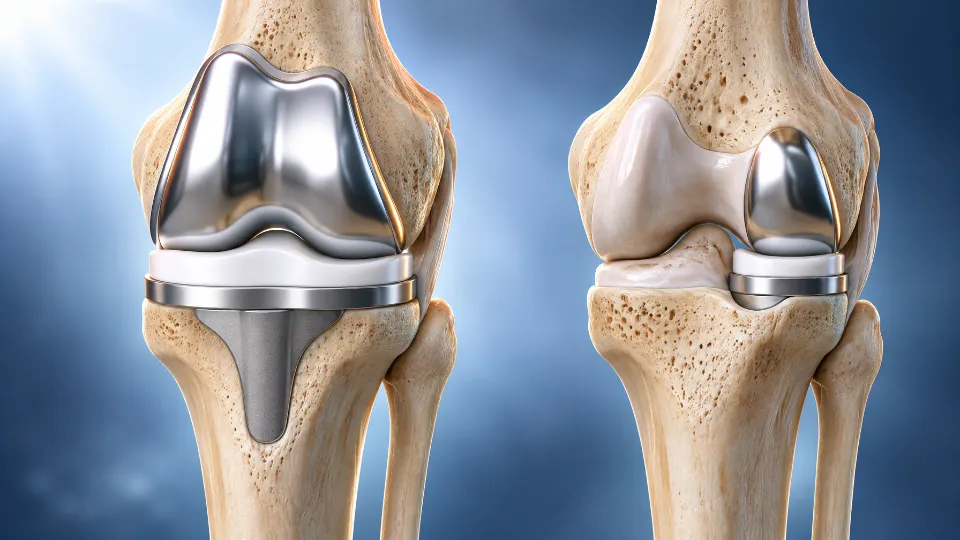
A total knee replacement removes the worn surfaces of the knee joint and replaces them with a metal and plastic implant. In a robotic-arm assisted knee replacement, the operation is the same, but a computer plan and a robotic arm help the surgeon prepare the bone so that the implant fits the plan.
The surgeon is in charge throughout. The robot does not decide anything on its own and does not operate independently.
Suyash Hospital, Raipur, is offering robotic-arm assisted knee replacement surgery using the Meril MISSO system. Whether it is suitable for your knee is decided only after examination, X-rays and a CT-based plan.
The system
About the Meril MISSO system: made in India by Meril
CT-based planning
A 3D model of your knee is created from a CT scan before surgery, and the surgeon plans implant size and position on it.
Optical tracking
Cameras track the position of your leg bones during the operation.
Robotic arm
Guides the surgeon's bone cuts to match the approved plan. The surgeon stays in control.
Bone-movement monitoring
The system monitors leg movement while the cuts are made.
Technical details are as described by the manufacturer, Meril. Ask Dr. Mittal how they apply to your knee.
Step by step
How a robotic-assisted knee replacement is planned and done
- Consultation and examination: Dr. Mittal examines your knee, reviews your X-rays and discusses all options, including non-surgical treatment.
- CT scan: if robotic surgery is chosen, a CT scan of the leg is done to build the 3D plan.
- Surgical plan: the surgeon plans implant size, position and alignment on the 3D model.
- In the operation theatre: the knee is opened as in a standard knee replacement; trackers let the system follow the bones.
- Bone preparation: the robotic arm guides the cuts, and the surgeon can adjust the plan during surgery.
- Implant and closure: the implant is fixed and the wound closed, as in conventional surgery. Rehabilitation and physiotherapy follow.
Honest picture
What robotic assistance does, and what it does not change
What it is designed to do: help the surgeon carry out a pre-planned implant position and bone cuts with precision. Published studies show robotic systems generally improve the accuracy of implant positioning and alignment compared with conventional instruments.
What it does not change: it is still a major operation with the same type of implant and the same general risks. Evidence on whether patients feel better in the long term than with conventional surgery is still developing. It usually adds a CT scan and may add some time in the operation theatre and some cost.
What studies show: Some studies have found that robotic knee replacement surgery results in less early postoperative pain and quicker early walking than conventional surgery. For example, a small, non-randomised pilot study from India reported lower early pain scores and higher early Knee Society Scores, which evened out by three months [1]. However, larger randomised trials, including a 2026 analysis of 24 trials, found no significant difference in pain or function between the two methods [2][3]. These benefits are therefore not established, and individual results vary.
References
[1] Kapoor C, et al. Cureus 2026;18(9):e117259. doi:10.7759/cureus.117259
[2] Abdelaziz O, et al. J Robot Surg 2026;20(1). doi:10.1007/s11701-026-03934-0
[3] Lizcano JD, et al. Clin Orthop Relat Res 2026;484(3):533-543. doi:10.1097/CORR.0000000000003734
Read the side-by-side explainer: robotic vs conventional knee replacement.
Suitability
Who may be considered for robotic knee replacement?
Robotic assistance is a way of doing a knee replacement, so it is considered only when a knee replacement itself is needed, for example:
- Advanced knee arthritis (osteoarthritis or rheumatoid arthritis) confirmed on X-rays
- Knee pain and stiffness that limit daily activities despite medicines, physiotherapy, weight management and other non-surgical treatment
- Deformity such as bow-legs or knock-knees caused by arthritis
Whether robotic or conventional surgery suits you is decided after examination, X-rays, the CT scan and a discussion of your preferences. Some knees and some medical conditions may be better managed with conventional surgery.
Before you decide
Risks, limits and questions to ask
All knee replacements carry risks, including infection, blood clots, wound problems, stiffness, nerve or blood-vessel injury, implant loosening and the possible need for further surgery. Robotic assistance does not remove these risks.
Questions worth asking any surgeon:
- Do I need a knee replacement now, or can I try other treatment first?
- Why do you suggest robotic or conventional surgery for my knee?
- What will the CT scan involve?
- What will the total cost be, and what does my insurance cover?
- What does rehabilitation involve, and who will guide it?
For an idea of what affects cost, see robotic knee replacement cost in Raipur.
Choosing an approach
Who may not need robotic assistance
Robotic assistance is one way of doing a knee replacement, not a requirement. Conventional surgery is just as reasonable in situations such as:
- Severe deformity or poor bone quality, where the surgeon may judge that conventional instruments are the better choice for your knee.
- When you prefer conventional surgery. Both approaches are accepted options, and the choice is yours after discussion with your surgeon.
Good to know
If robotic assistance cannot be used during surgery
Before surgery you are told that the operation can be completed with conventional instruments if the robotic system cannot be used, or if the surgeon decides conventional instruments are safer. Your consent covers both approaches, and the decision is made on the day, on grounds of safety.
Hospital package: if an operation planned as robotic is completed with conventional instruments, the hospital package remains the same. Please confirm what the package includes with the hospital billing desk before surgery.
Where to meet Dr. Mittal
Consultation in Raipur
Dr. Sameer Mittal is a joint replacement and arthroscopic surgeon (MBBS, D.Ortho, DNB Orthopaedics) at Suyash Hospital, Raipur. At the OPD visit he will examine your knee, review your reports, explain conventional and robotic-assisted options, and answer your questions.
Also read: knee replacement in Raipur and second opinion for knee replacement.
Where to consult
Clinics and timings
Suyash Hospital, Raipur
OPD No. 9, Gudhiyari Main Road, Kota, Raipur 492010
Monday to Saturday, 10 am to 6 pm
Balaji Medicare, Fafadih
Near Pili Building, in front of Parag Hospital, Fafadih, Raipur
Monday to Friday, 7 to 9 pm
Visiting clinic, Bilaspur
Behind Sagar Golden Square, Mangala Chowk, Bilaspur
Alternate Sundays, 12 to 3 pm (please confirm your slot)
Call / WhatsApp: +91 88395 91330 · WhatsApp booking: +91 88395 91330. Please bring earlier X-rays, MRI reports and a list of your current medicines.
FAQ
Common questions
Does the robot perform the operation?
No. The surgeon performs the operation. The robotic arm helps the surgeon carry out the bone cuts according to a plan the surgeon has made and approved, and the surgeon controls every step.
Is robotic knee replacement a different implant?
No. It is still a total knee replacement with a knee implant. What changes is the planning and the way the bone is prepared to fit the implant.
Will I need a CT scan?
With the MISSO system the plan is made on a CT scan of your leg, so a CT scan is usually needed before surgery. It involves a dose of X-ray radiation, which the team will explain.
Is robotic surgery right for everyone who needs a knee replacement?
Not always. Suitability depends on your knee, your X-rays and CT scan, your general health and your preferences. Conventional knee replacement remains a well-established option.
Does robotic surgery remove the usual risks of knee replacement?
No. The usual risks of knee replacement, such as infection, blood clots, stiffness and the need for revision in future, still apply. Dr. Mittal discusses these at the consultation.
What should I bring to the consultation?
Your recent knee X-rays, any MRI or CT reports, a list of your medicines and other illnesses, and your insurance or TPA details if you have them.
More: Robotic vs conventional · Cost and insurance · Knee replacement
Written by Dr. Sameer Mittal, MBBS, D.Ortho, DNB Orthopaedics, Joint Replacement and Arthroscopic Surgeon, Raipur (Chhattisgarh Medical Council Reg. No. 3016/2010). This page is for general education and is not a substitute for an in-person consultation. Treatment is decided only after examination and investigations.
Have questions about robotic knee replacement?
Bring your X-rays and reports to an OPD consultation with Dr. Sameer Mittal at Suyash Hospital, Raipur.